
The post-efficiency space fellowship
A design-led inquiry into the psychological and sensory architecture required for long-duration life beyond Earth.
Survival is a feat of engineering •
Flourishing is a feat of design
·
·
Survival is a feat of engineering • Flourishing is a feat of design · ·
SUMMER 2026
For decades, space exploration has prioritized engineered efficiency: the minimum viable volume, the most caloric density, the strictest life-support tolerances. As we move from short-term stints in space to multi-year missions and orbital habitation, the metric of success must shift.
This summer, the Post-Efficiency Space Fellowship is investigating the 'soft systems'—aesthetics, circadian light, tactile textures, and spatial psychology—that transform a pressurized vessel into a home
Why is gravity depicted in this rendering of a spacecraft that is not anchored to a planetary body?
One of the things we’re investigating is the “comfort” effect gravity might offer to astronauts on long duration flights. It is possible that artificial gravity might play an important role in mental health and physical well being… we look forward to finding out.
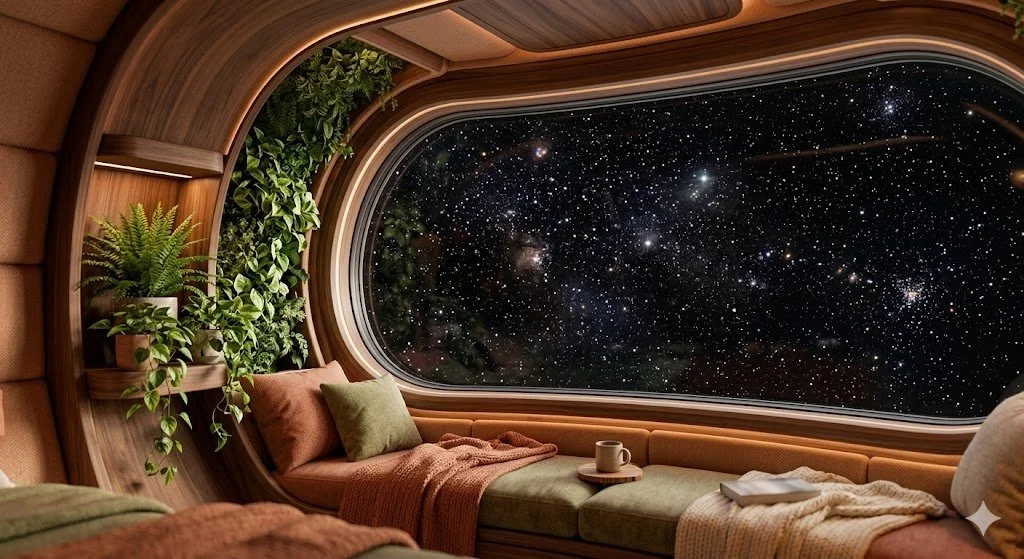
We’re investigating…
-

Sensory Sovereignty
How can we mitigate the sensory deprivation of sterile environments?
-

The Domestic Ritual
How will the 'mundane' (eating, sleeping, hygiene) be reimagined to support long-term mental health?
-

Aesthetic Agency
What are the psychological impacts of personalization and beauty in zero-gravity?
-

Zero Gravity, Zero Limitations
What earth-bound design practices might we flip-on-their heads to design for life without gravitational restraint?
DEAR ASTRONAUTS,
A NOTE TO OUR PARTICIPANTS
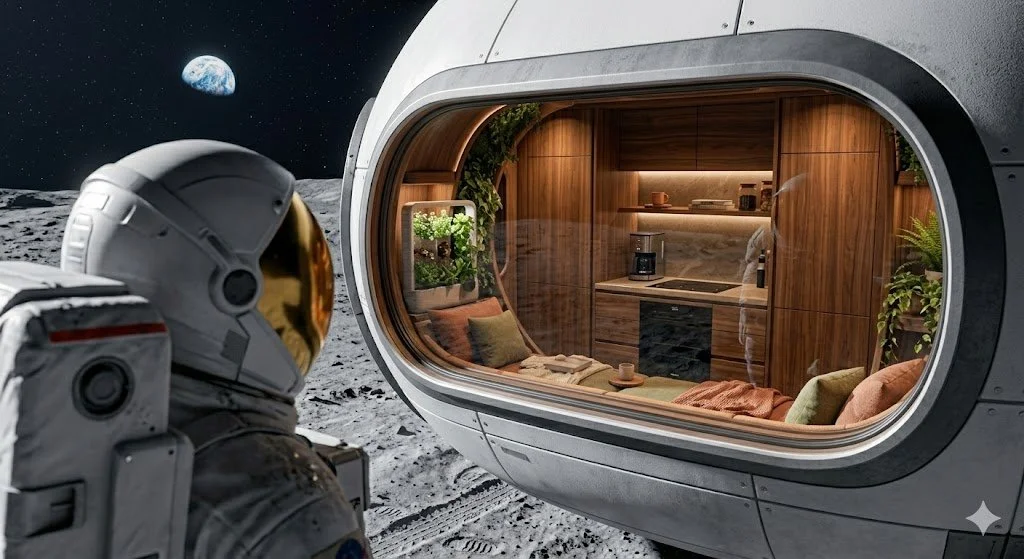
We recognize that you are the world’s most elite 'users' of extreme environments. Our goal is not to debrief you on technical malfunctions, but to listen to your human experience. We want to understand the intangible things you missed, the sensory gaps you felt, and what you would change if 'survival' was no longer the overwhelming priority. Your insights will directly shape the design principles of the next century of space travel.
THE FELLOWSHIP TEAM
PRINCIPAL INVESTIGATOR
Kelly LaPlante
RESEARCH FELLOWS
Natalie Hill, Italian Design Institute
Stella Perone, University of Utah
Tara Williams, Washington University in St. Louis